
Discover the Versalift VTL — Europe’s Leading Van-Mounted Telescopic Platform
What is the Versalift VTL?
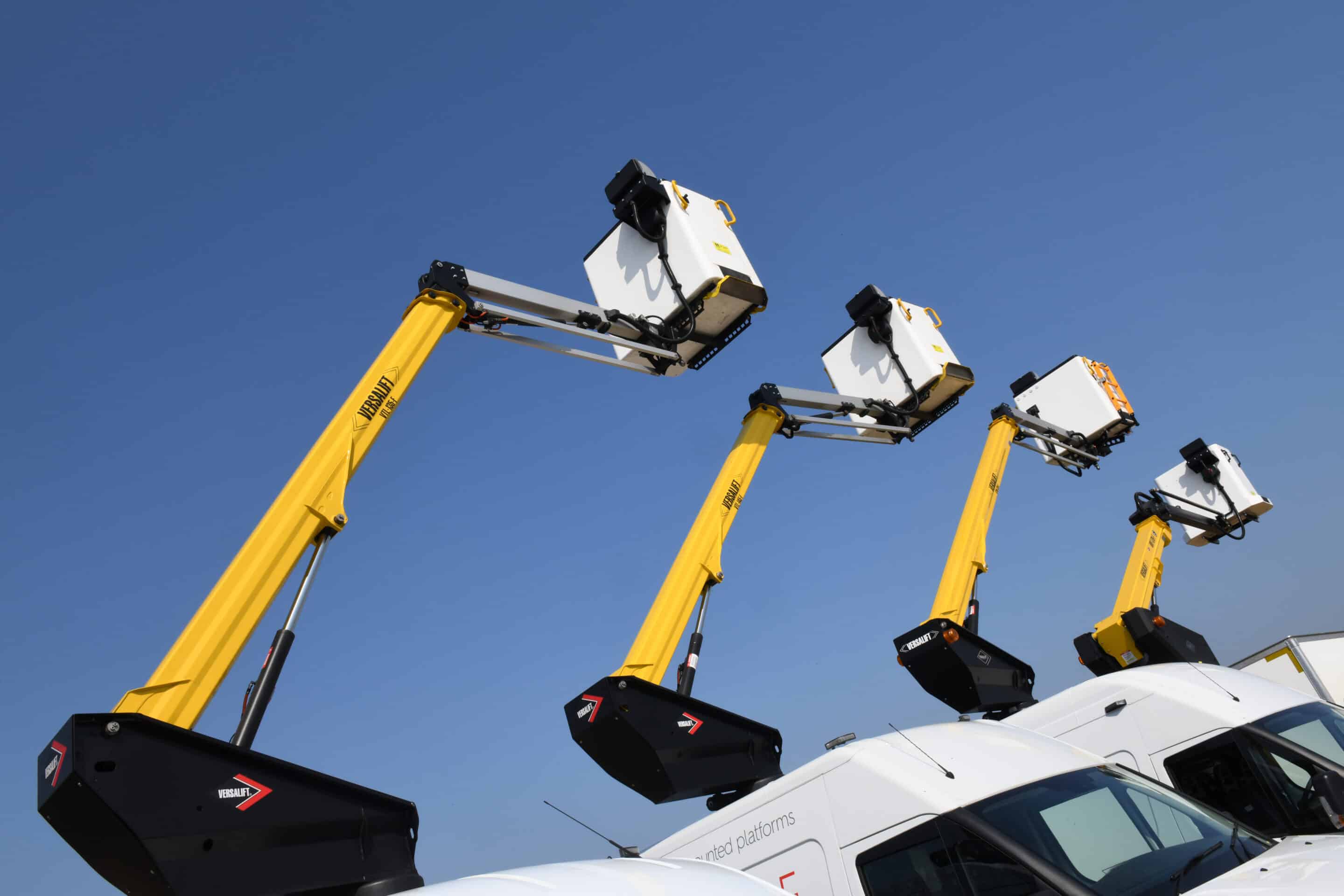
The Versalift VTL (Van-Mounted Telescopic Lift) is a class of van-mounted telescopic platforms designed to provide safe, efficient access to height while retaining van mobility and payload capacity. Versalift offers several VTL models (e.g. VTL-135-F, VTL-145-F, VTE-125) each optimised for different reach, outreach, payload, and vehicle chassis configurations.
Key aspects:
- The boom is telescopic, often with a fly-boom articulation (e.g. 140° flyboom on many models).
- Rotation is typically full 360° or more (many models offer full turret rotation) for versatility on site.
- Outriggers or stabilisers are used (commonly A-frame style) to stabilise before lifting operations.
- Control systems use Versalift’s LMC (Load Moment Control) systems to govern safe operation and prevent overload or reach instability.
- Models are available in diesel, hybrid, and all-electric variants to suit emissions legislation and low emission zones. For example, the All-Electric VTL-135-F is built for emission-sensitive environments.
This blend of van mobility and telescopic lift makes the VTL ideal for tasks such as utilities, telecommunications, street lighting, signage, and maintenance across urban and rural settings.
VTL in Action: Use Across Europe
The VTL range is deployed widely across Europe by contractors, utility companies, telecom operators, and municipal services. Key trends and examples:
Coverage in Nordic & European Markets
- In Denmark and across Scandinavia, Versalift’s European arm promotes VTL models as core van lifts for access and service operations.
- The VTL-145-F, for instance, is offered on Mercedes-Benz Sprinter chassis in several European markets, providing reach, flexibility, and safety in continental environments.
UK Usage & Market Adaptation
- In the UK, the VTL-135-F is a “bestseller” model. Its specs include a working height of 13.5m, an outreach of 8.4m, 230 kg bucket capacity, and 380kg payload, after driver, passenger and fuel.
- Versalift UK recently achieved Ford Pro Convertor status, enabling conversions of the new fully automatic Ford Transit with the VTL platform, which supports integration with modern fleet choices.
Applications & Industries
Across Europe, operators use VTLs for:
- Telecommunications & Fibre: for pole and mast access, network maintenance, installation of antennas and cabling. Versalift emphasises its platforms’ reach, insulation, and compact design for telecom applications.
- Utilities & Electrical Maintenance: inspecting and servicing overhead lines or street lighting, often with insulated booms or buckets.
- Street Lighting & Signage: ideal for access in tight urban settings, with sufficient outreach and elevation.
- Municipal & Facilities Maintenance: gutter cleaning, façade access, tree trimming in built environments.
- Low Emission Zones / City Use: electric/hybrid versions make deployment feasible in emission-restricted zones.
The VTL is an integral part of aerial access fleets across many countries.
Structure and Design of a VTL Platform
To understand what makes the VTL effective, here’s a breakdown of its primary structural elements and design features:
Chassis & Vehicle Integration
- The base vehicle is typically a van (e.g. Ford, Iveco, Renault) with sufficient GVW to accommodate the lift plus payload.
- Versalift ensures integration that retains as much payload and workshop capacity as possible.
- The conversion is engineered so that the lift and supporting structure don’t overly compromise vehicle durability, centre of gravity, or handling.
Boom & Fly-Boom
- The main boom is telescopic, built from high-strength steel.
- A fly-boom (often 140°) allows angular adjustment near the tip, improving flexibility in tight or offset positions.
- The boom is often encased or coated to resist corrosion in harsh weather conditions.
Turret, Slew & Rotation
- The turret rotates (commonly 360°) to allow positioning of the boom in any direction without repositioning the van. Some models exceed 360°.
- Slew interlocks or rotation limits may be designed to prevent overreach or collision with the vehicle body.
Outriggers / Stabilisation
- A-frame outriggers are common to level and stabilise the vehicle before lifting operations.
- Some models are designed for “jackless” or limited outrigger designs to reduce setup time or footprint (especially useful in confined environments). The VTE-125 mounted on a Renault, and all-electric VTL-135-F are some of the platforms in this range.
- Slope tolerance (e.g. longitudinal 5°, side slope 3°) is factored into design to allow safe working on moderate terrain.
Platform / Bucket & Controls
- The bucket (platform) capacity typically ranges around 200–230 kg (i.e. two operators + tools).
- Rotating buckets (often ±90° or 420° options) help accurate positioning without repositioning the boom.
- Control is usually via joysticks at ground and platform level, integrated into the LMC system for safe proportional control.
- Ground-level emergency lowering is standard for safety.
Power, Insulation & Emissions
- Many units are powered through the vehicle engine via PTO or belt drive, or via auxiliary power packs (electric, hybrid).
- All-electric variants like VTL-135-F use battery packs and single-point charging to reduce emissions in low emission zones.
- Insulated versions (1kV rating in many cases) are available for work near live electrical assets.
Benefits and Competitor Advantage
The Versalift VTL offers operators clear advantages across Europe. Being van-mounted, it provides quick set-up on site without the need for trailers, reducing downtime and simplifying logistics. Despite the installation of the lift, models such as the VTL-140-F retain a useful payload of around 290 kg, allowing space for tools and parts.
Safety is built in, with features like Load Moment Control, emergency lowering, outriggers, slope compensation and optional insulation keeping the platform compliant and reliable. Electric and hybrid versions also ensure fleets can operate in low-emission zones and meet stricter environmental standards.
Thanks to its telescopic reach and compact footprint, the VTL is highly versatile — from telecoms and utilities to street lighting and municipal maintenance — making it one of the most flexible and future-ready van-mounted platforms available.
Get In Touch
In summary, the Versalift VTL is a powerful, versatile, and well-engineered van-mounted telescopic platform used across Europe in multiple industries. Its thoughtful structural design, range of power options (diesel, hybrid, all-electric), and safety features make it a premium MEWP choice for working at height.
If you’d like to explore the VTL range, request a demo, or discuss specification options for your fleet, contact our Versalift UK sales team today.
Follow us for our latest news, advice and products.